
Professional medical scrubs should balance workplace appearance with practical performance. A suitable scrub set needs to fit properly, support repeated movement, provide useful storage, suit the work environment, and remain practical for regular laundering. Color and style matter, but professionalism also depends on garment condition, fit, fabric behavior, and compliance with employer dress requirements.
Well-chosen professional medical scrubs should help healthcare workers move through normal duties without frequent clothing adjustments or unnecessary garment bulk. The goal is not to find one universal scrub style. It is to select workwear that suits the role, workplace, body proportions, and expected daily movement.
Key Takeaways
Healthcare professionals should evaluate scrubs based on:
- Fit: The garment should allow normal movement without excessive tightness or unnecessary looseness.
- Fabric: Consider stretch, weight, drape, durability, and care requirements.
- Professional appearance: Scrubs should look clean, coordinated, and appropriate for workplace expectations.
- Function: Pocket placement, waistband design, closures, and layering should support daily tasks.
- Movement: Tops and pants should be tested while sitting, bending, reaching, and walking.
- Workplace requirements: Employer dress codes, color policies, and safety procedures take priority over personal style preferences.
- Maintenance: Scrubs should fit the wearer’s realistic laundry and garment care routine.
Professional scrubs are most effective when appearance and workday function are considered together.
What makes medical scrubs look professional?
Professional appearance is not determined by one specific neckline, pant silhouette, or fabric.
Several factors work together.
These include:
- Proper garment fit
- Appropriate workplace colors
- Clean and well-maintained fabric
- Coordinated tops and pants
- Practical garment length
- Suitable pocket use
- Workplace-appropriate styling
A scrub set can be modern and still look professional. Likewise, a traditional design can appear unsuitable if the garment is excessively worn, poorly fitted, or inconsistent with employer policies.
Fit has a major effect on appearance
Scrubs that are extremely tight may pull across the shoulders, torso, hips, or thighs.
Excessively loose garments may create unnecessary bulk or appear difficult to manage during active work.
A professional fit usually provides enough room for movement while allowing the garment silhouette to remain intentional.
The wearer should evaluate the scrub set from several positions.
Stand normally.
Sit down.
Reach forward.
Raise the arms.
Walk naturally.
The garment should remain reasonably stable without requiring constant adjustment.
Garment condition matters
Even well-designed scrubs can lose a professional appearance when they are heavily worn or damaged.
Healthcare professionals should regularly check for:
- Frayed seams
- Damaged closures
- Loose drawstrings
- Excessive fabric wear
- Persistent discoloration
- Stretched waistbands
- Damaged pockets
Workwear does not need to look new every day, but it should remain functional and appropriate for the workplace.
How should professional medical scrubs fit?
Professional scrubs should allow practical movement without creating unnecessary excess fabric.
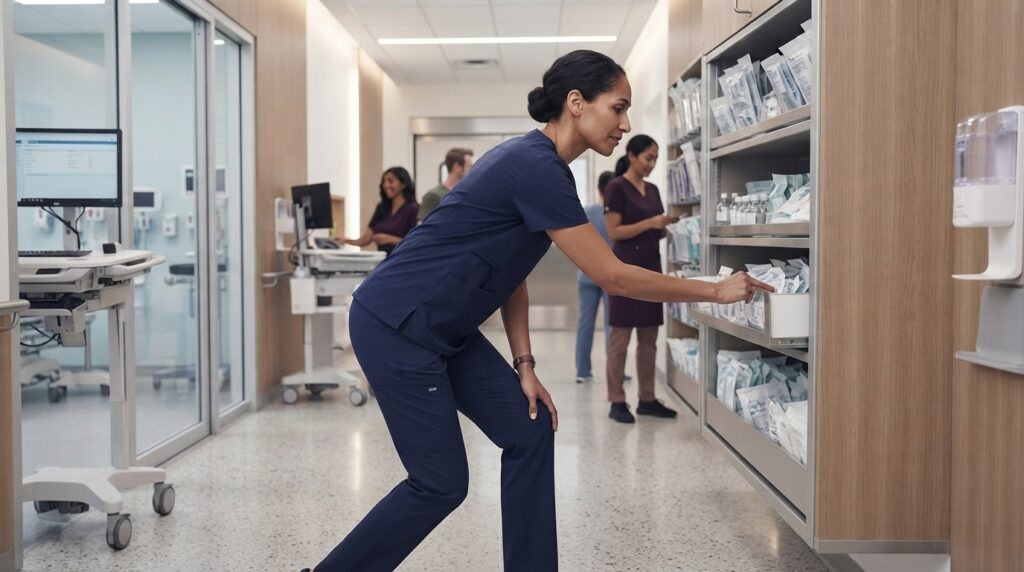
The correct fit depends on body proportions and garment design.
Scrub tops should allow shoulder movement
Healthcare work may require frequent arm movement.
A top should provide enough room through the shoulders and upper back for actions such as:
- Reaching toward storage
- Moving equipment
- Working at different heights
- Extending the arms forward
- Layering over an underscrub
A simple movement test can help.
Reach both arms forward and then raise them.
If the fabric pulls severely across the upper back or shoulders, the size or garment cut may be unsuitable.
However, choosing a much larger top is not automatically the solution.
The overall torso and garment length must also be considered.
Check scrub top length
A professional scrub top should remain practical while standing, sitting, and bending.
A very short top may ride upward repeatedly.
An excessively long top may create bulk around the hips or interfere with sitting.
The preferred length can also depend on the pant rise and whether the top is designed to be tucked in.
Women comparing silhouettes and garment proportions may benefit from reviewing dedicated women’s medical scrubs rather than assuming that every scrub top and pant combination will fit the same way.
Scrub pants should support sitting and walking
Scrub pants should be tested through the hips, thighs, knees, waist, and lower leg.
The wearer should be able to:
- Sit comfortably
- Bend the knees
- Take a long step
- Walk at a normal pace
- Move from sitting to standing
The waistband should remain reasonably secure while the fabric should provide enough room for movement.
Pant silhouettes also matter.
Joggers, tapered pants, wide-leg styles, flare pants, and more traditional cuts may distribute fabric differently around the legs.
The correct silhouette depends on movement preferences and workplace expectations.
Which scrub fabrics create a professional appearance?
Fabric influences how scrubs move, drape, and maintain their shape during wear.
A professional appearance does not require one specific fiber.
Modern scrub fabrics may contain:
- Polyester
- Recycled polyester
- Rayon
- Spandex
- Cotton
- Blends of several fibers
The complete textile construction is more important than judging the garment by one fiber alone.
Structured fabric versus fluid drape
A more structured fabric may create defined garment lines.
A softer material with fluid drape may move more naturally around the torso or legs.
Both can look professional.
The preferred option depends on:
- Garment cut
- Body proportions
- Workplace setting
- Personal comfort
- Desired silhouette
Fabric drape should be evaluated while moving, not only while standing in front of a mirror.
Stretch can support a cleaner fit during movement
Stretch helps fabric accommodate body movement.
This may reduce severe pulling when the wearer bends or reaches.
However, stretch cannot correct a fundamentally incorrect garment size.
A scrub set still needs suitable room through the shoulders, hips, and legs.
Fabric recovery matters
Recovery refers to the fabric’s ability to move back toward its original dimensions after stretching.
Workwear may be repeatedly stretched around:
- Knees
- Elbows
- Hips
- Waist
- Upper back
A fabric with appropriate recovery can support more consistent garment shape during regular wear.
How important is color when choosing professional scrubs?
Color can be influenced by workplace policy, department requirements, branding, or personal preference.
Some healthcare organizations use specific colors to distinguish staff roles or clinical departments.
Workers should always check employer dress requirements before purchasing new workwear.
Professional appearance is not determined by choosing a dark or neutral color.
A bright scrub color may be entirely appropriate in one workplace and restricted in another.
The important issues are:
- Employer policy
- Department requirements
- Garment condition
- Color consistency where required
Coordinated colors can create a polished appearance
Matching tops and pants can create a consistent look.
However, some workplaces allow coordinated color combinations.
When mixing garments, consider whether the fabric finish and shades work together.
Two garments described with a similar color name may appear slightly different because of fabric composition, dyeing, or garment construction.
Healthcare professionals who need a consistent uniform appearance may prefer to coordinate pieces from compatible ranges or collections.
Which pockets are most useful in professional medical scrubs?
Pocket count should reflect the wearer’s normal responsibilities.
More pockets do not automatically make a scrub set more professional or functional.
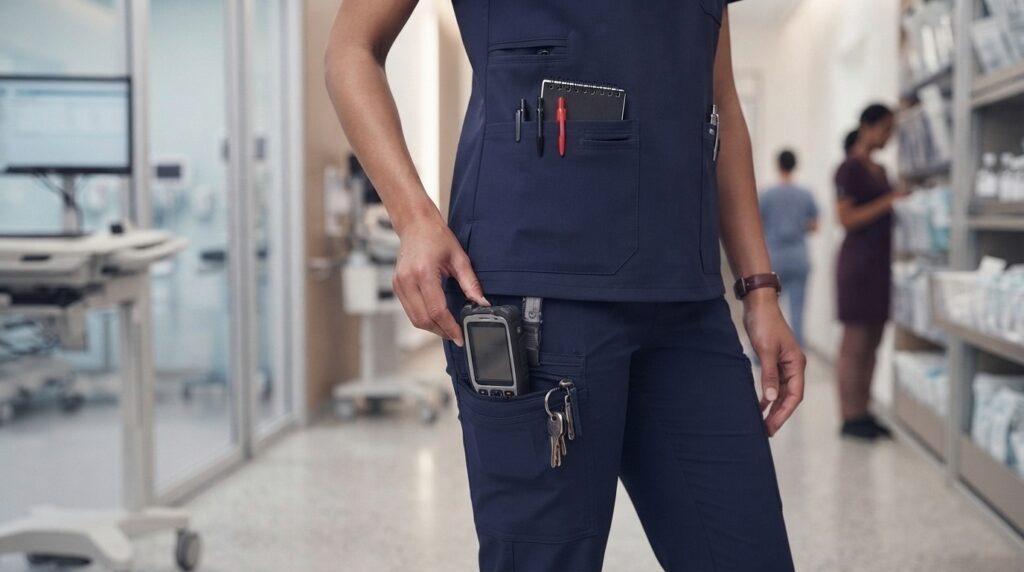
The better question is:
What does the wearer actually need to carry?
Depending on the role and workplace rules, common items may include:
- Pens
- Small notes
- Identification items
- Communication devices
- Approved work tools
Pocket placement affects garment appearance
Heavily loaded pockets can change the way scrubs hang.
A top pocket filled with several items may pull the garment downward.
Bulky cargo pockets can add weight around the legs.
Healthcare professionals should select storage based on real daily use and avoid carrying unnecessary items.
Secure pockets may suit active roles
Workers who walk quickly or change position frequently may prefer deeper or more secure storage.
Possible pocket features include:
- Zipper closures
- Deeper patch pockets
- Cargo pockets
- Interior compartments
The closure should still be easy to use during normal work.
Function and accessibility should be considered together.
How should professional scrubs support movement?
Professional healthcare workwear needs to function during actual job movements.
A healthcare professional may move repeatedly between standing, sitting, reaching, walking, and bending.
Scrubs should therefore be evaluated dynamically.
Test shoulder mobility
Raise the arms.
Reach forward.
Cross the arms over the torso.
The top should not create severe restriction.
Test hip and knee mobility
Sit down.
Take a wide step.
Bend at the knees.
The pants should move without excessive tension through the hips or thighs.
Evaluate the waistband
The waistband should remain secure during movement.
Check whether it:
- Rolls
- Slips
- Creates excessive pressure
- Requires frequent adjustment
Waistband options may include yoga-style construction, full elastic, half elastic, drawstrings, or combination designs.
The best design depends on individual fit preference.
Men evaluating different top and pant combinations can use dedicated men’s medical scrubs to consider garment categories together rather than selecting each piece without regard to overall fit and movement.
Should professional scrubs be fitted or relaxed?
Both fitted and relaxed scrubs can be professional.
The correct choice depends on workplace requirements, garment design, and wearer preference.
Fitted scrubs
A more shaped scrub design may create a streamlined silhouette.
However, the garment should still allow normal movement.
Signs that a fitted scrub may be too tight include:
- Strong pulling across the shoulders
- Fabric tension at the buttons or closures
- Restricted sitting
- Severe pulling at the hips
- Limited arm movement
Relaxed scrubs
Relaxed garments provide additional room.
They may appeal to workers who prefer more space through the torso or legs.
However, excessively loose garments may create unnecessary bulk.
The best fit provides comfortable movement while remaining practical for the healthcare environment.
Do scrub jackets contribute to a professional uniform?
Scrub jackets can provide an additional coordinated layer.
They may be useful in workplaces with changing temperatures or for healthcare professionals who prefer an extra garment layer.
When choosing a scrub jacket, consider:
- Shoulder movement
- Sleeve length
- Jacket weight
- Closure type
- Pocket location
- Overall length
The jacket should fit comfortably over the normal scrub top.
A jacket that feels appropriate when worn alone may become restrictive when layered.
Check the complete uniform together
Try on the top, pants, and jacket as a complete outfit.
Move the arms and sit down.
The combined layers should not create excessive bulk or movement restriction.
This is especially important around the shoulders and upper arms.
How should doctors choose professional scrubs?
Doctors should consider their actual work setting and duties.
A physician working in a procedural environment may have different clothing requirements from one working primarily in outpatient consultation.
Factors to evaluate include:
- Employer dress policy
- Required color
- Movement demands
- Pocket needs
- Layering
- Garment fit
- Fabric weight
Role title alone should not determine the correct scrub design.
The actual workplace and tasks are more useful guides.
How should nurses evaluate professional scrubs?
Nurses may perform repeated movement throughout a shift.
Depending on the role, this can include walking, bending, reaching, sitting, assisting patients, and handling work equipment.
Professional scrub priorities may therefore include:
- Movement-friendly fit
- Practical stretch
- Accessible storage
- Secure waistbands
- Appropriate fabric weight
- Durable construction
Shift length and workplace temperature can also influence comfort preferences.
No single silhouette works for every nurse.
A practical fitting test is more useful than relying only on size labels.
What should dental and veterinary professionals look for?
Dental and veterinary work can involve distinct movement patterns.
Dental professionals may spend substantial periods seated or leaning toward patients.
Veterinary workers may frequently bend, crouch, or move around animals and equipment.
The same general principles still apply:
- Test movement
- Check shoulder fit
- Evaluate pant mobility
- Consider pocket use
- Review fabric care
- Follow workplace policy
The garment should suit the actual work environment rather than a generic idea of healthcare clothing.
How important are scrub care requirements?
Medical scrubs are workwear and may be laundered frequently.
Care requirements should therefore be considered before purchase.
The CDC discusses uniforms and scrub suits within its broader healthcare laundry and textile guidance.
Healthcare workers should follow facility procedures for handling work clothing and contaminated textiles.
Garment-specific care instructions also matter.
Before choosing professional scrubs, review:
- Washing instructions
- Drying recommendations
- Water temperature guidance
- Bleach restrictions
- Ironing requirements
- Fabric composition
Scrubs that require a maintenance routine incompatible with the wearer’s schedule may become inconvenient.
Regular garment inspection is useful
After laundering, check:
- Seams
- Waistbands
- Drawstrings
- Zippers
- Pocket attachment
- Fabric condition
Damaged workwear should be repaired or replaced when it no longer functions appropriately.
Are professional medical scrubs considered PPE?
Ordinary medical scrubs should not automatically be treated as personal protective equipment.
OSHA distinguishes ordinary uniforms or scrubs worn similarly to street clothing from PPE in its bloodborne pathogens interpretation guidance.
OSHA’s broader personal protective equipment guidance explains that PPE is intended to minimize exposure to workplace hazards.
NIOSH also provides separate information about protective clothing used in healthcare.
Where a task requires gowns, protective clothing, or other hazard-specific equipment, workers should follow applicable workplace procedures.
A professional scrub uniform does not replace required PPE.
How can healthcare workers test scrubs before choosing them?
A short fitting routine can reveal problems that are not obvious while standing still.
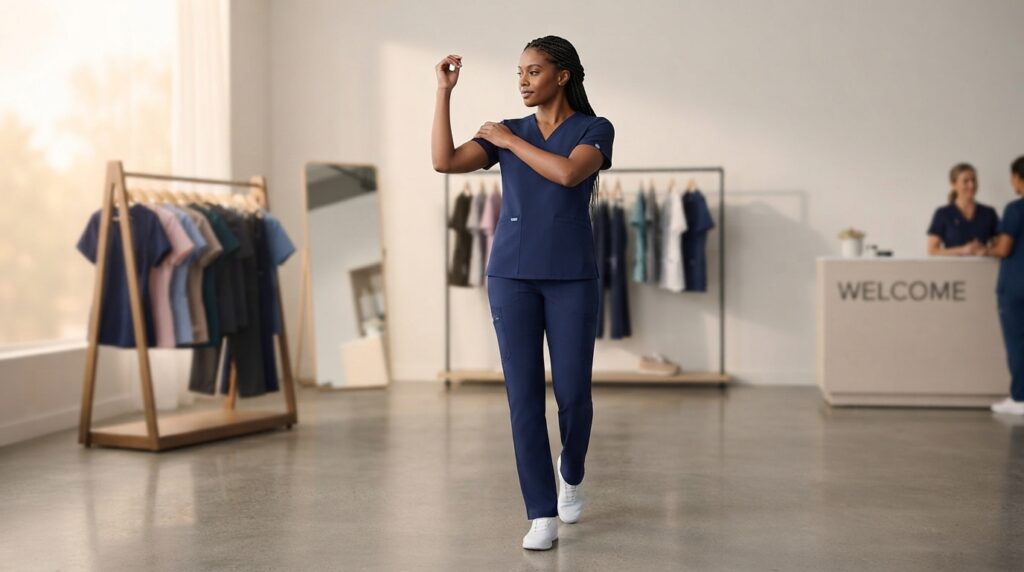
Step 1: Check basic standing fit
Stand naturally and examine:
- Shoulder fit
- Torso room
- Waist position
- Hip fit
- Pant length
The garment should not require immediate adjustment.
Step 2: Sit down
Remain seated for several minutes.
Notice waistband pressure, pant rise, and top length.
Step 3: Reach forward and upward
Test the shoulders, upper back, and top hem.
Look for strong pulling.
Step 4: Bend and walk
Take several steps and bend at the knees.
Evaluate the hips, thighs, and lower legs.
Step 5: Test the pockets
Place the normal lightweight work items in the intended storage areas.
Check whether the garment becomes unbalanced or uncomfortable.
Step 6: Add normal layers
Wear the usual underscrub or jacket.
The complete outfit should still allow movement.
What should healthcare professionals prioritize when selecting scrubs?
A practical order of priorities is:
- Workplace requirements
- Correct fit
- Freedom of movement
- Fabric comfort
- Useful storage
- Appropriate garment weight
- Practical care
- Preferred style
This order can vary by role, but workplace safety and dress requirements should always be considered first.
Style is still relevant.
Healthcare professionals spend significant time in workwear, and many prefer scrubs that reflect modern clothing preferences.
The strongest choice combines professional appearance with practical function.
Final thoughts
Professional medical scrubs should be selected as workwear rather than judged only as fashion.
Fit, fabric, movement, pockets, waistband design, layering, garment condition, and care requirements all influence how suitable a scrub set is for daily healthcare work.
A professional appearance comes from more than choosing a specific color or silhouette. Scrubs should remain practical while the wearer sits, bends, walks, reaches, and performs normal duties.
Healthcare professionals should begin with workplace requirements, test garments through realistic movement, and choose features based on daily responsibilities.
The result should be scrubs that look appropriate, feel comfortable, and support the practical demands of the workday.
Frequently Asked Questions
What makes medical scrubs look professional?
Professional scrubs generally fit properly, remain clean and well maintained, meet workplace dress requirements, and provide a coordinated appearance. Garment condition, fit, color policy, and practical design are more important than following one specific scrub style.
Should professional scrubs be tight or loose?
Neither extreme is ideal for most wearers. Scrubs should provide enough room for sitting, bending, reaching, and walking without excessive pulling or unnecessary garment bulk. The preferred silhouette can be fitted or relaxed as long as it supports practical movement.
What fabric is best for professional medical scrubs?
There is no single best fabric. Healthcare professionals should evaluate stretch, recovery, fabric weight, drape, durability, and care requirements. The best fabric depends on the workplace environment, movement demands, and individual comfort preferences.
Are jogger scrubs professional?
Jogger scrubs may be appropriate in workplaces that permit the silhouette. Professional appearance depends on employer dress policies, garment fit, color requirements, condition, and overall coordination. Workers should always follow their organization’s dress standards.
How many pockets should professional scrubs have?
The appropriate pocket count depends on the wearer’s role. Healthcare professionals should consider what they actually carry during work and choose accessible storage accordingly. Pocket placement and security can be more useful than simply selecting the garment with the most pockets.
Do professional medical scrubs count as PPE?
Ordinary uniforms or scrubs generally should not be treated as PPE. Protective equipment is selected according to workplace hazards and applicable safety requirements. Healthcare workers should follow employer policies and required PPE procedures for specific tasks.